
What Starke County Deeds Record
Deeds land at the Starke County Recorder once they meet Indiana recording standards. Every instrument names the parties and carries a legal description. It conveys whatever interest its language allows. The deed type hints at the story behind the transfer. The document itself still controls. Recorders index and preserve each filing. Staff cannot run a title search, though. They also cannot hand out legal advice.
| Deed Type | What It Does | Common Use |
|---|---|---|
| Warranty deed | Conveys the stated interest with deed warranties | Ordinary sale or transfer |
| Quitclaim deed | Conveys whatever interest the grantor has | Family or title cleanup |
| Personal representative deed | Conveys through an authorized estate representative | Probate sale or distribution |
| Survivorship or transfer-on-death deed | Uses recorded terms for a death-related transfer | Estate planning and later title work |
| Sheriff or tax deed | Records a transfer after the required legal process | Foreclosure or tax-sale chain |
Not everything recorded beside the deeds is a deed. A mortgage secures a debt. A release can close out an earlier instrument, and an easement may burden or benefit land without moving the whole parcel. Plats and surveys play their own roles too. Search each class separately, matching legal descriptions and references as you go.
Starke County Tapestry Access
The Recorder routes public users to Tapestry EON for non-member index and image research. Documented search fields cover grantor and grantee names, recording-date ranges, document numbers and types, consideration, subdivision, lot, block, parcel number, and legal-description terms. Start lean. Enter only a couple of fields first. A name or lot number that is exact but slightly off in form can bury the deed records you want. The Starke Tapestry entry point opens the recorder channel.
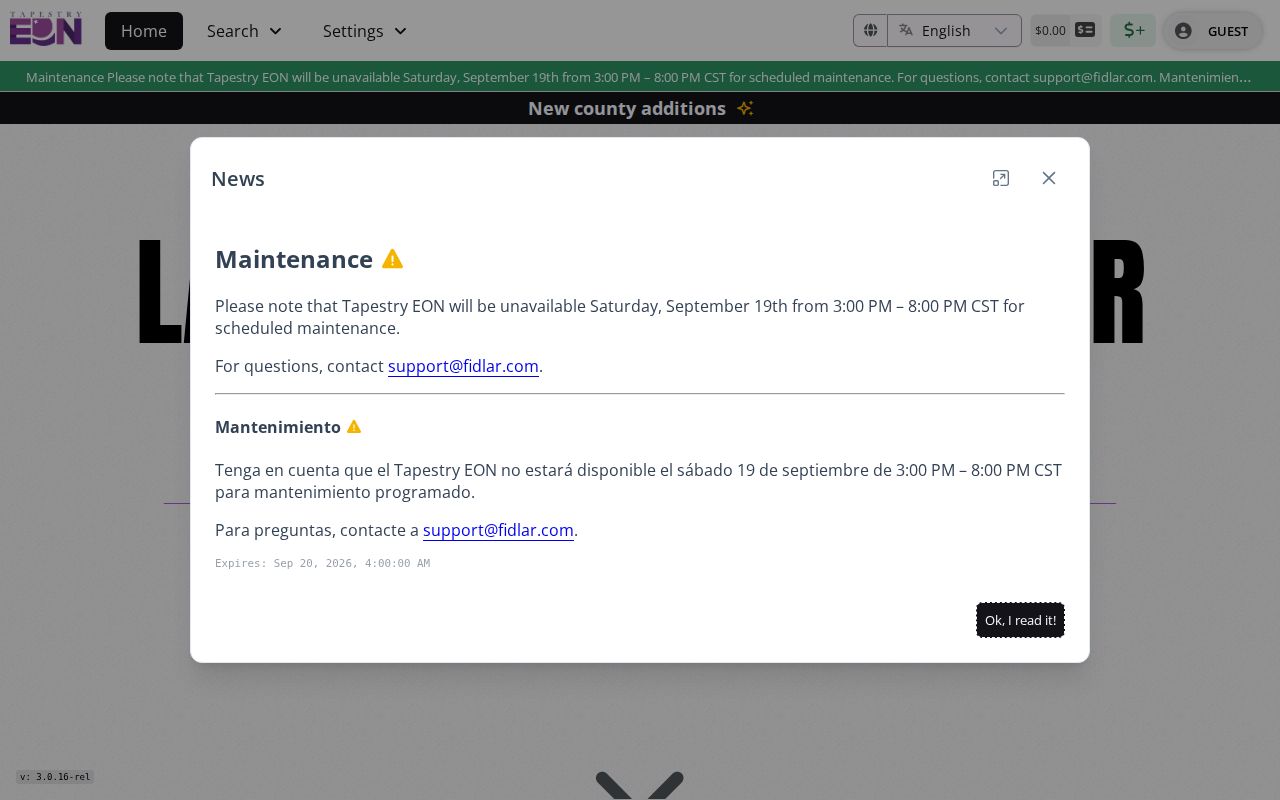
The login page marks where an online Starke County deed search begins. Check the live session for current payment and image terms.
Starke Deed Index Date Lines
Coverage lines differ by record class in Starke County. Scans reach back to 1850, deed indexes to 1967, miscellaneous-instrument indexes to 1961. Mortgage indexes reach to 1997. An 1850 scan span does not put every old deed behind a modern owner-name search. Older books may demand a grantor and grantee volume, a book and page cite, or a plat clue. They may instead need help at the Recorder's counter. The Starke County Recorder page publishes the coverage and office details.
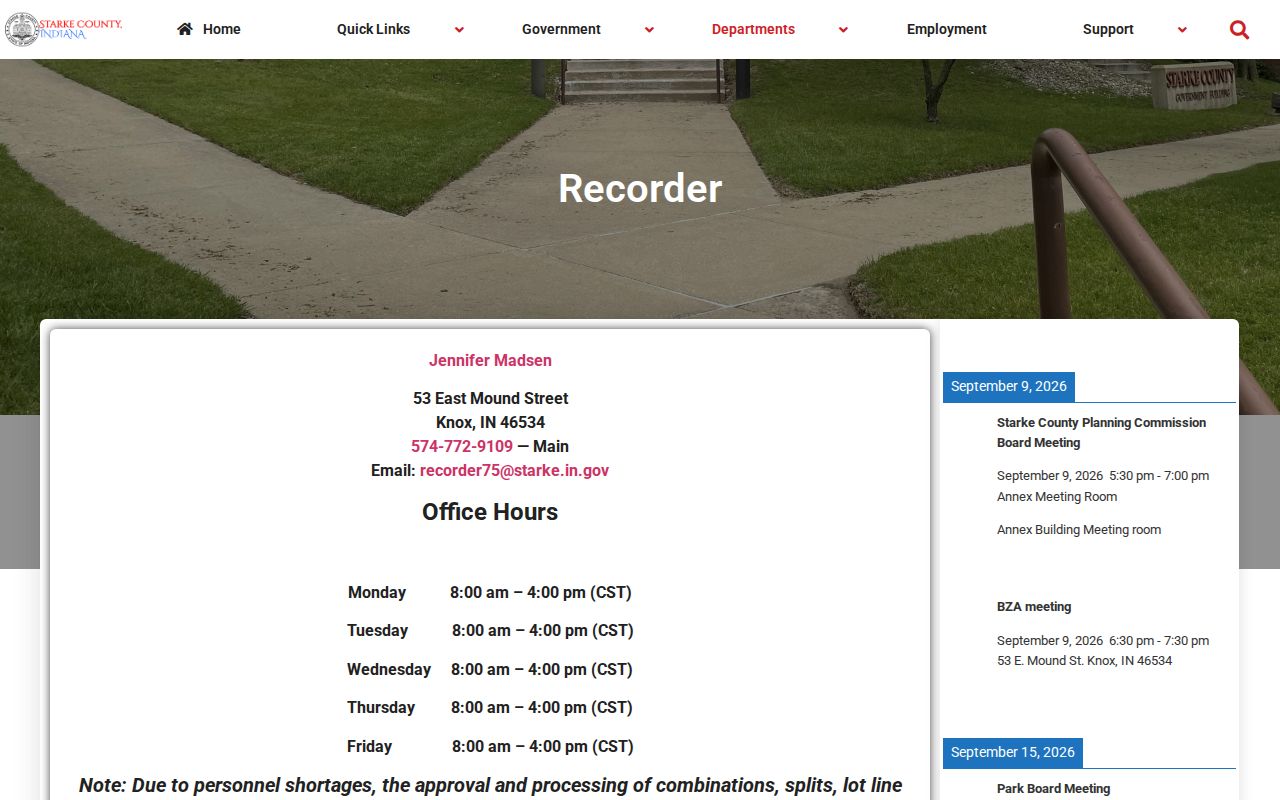
The same page points researchers to Property Fraud Alert and notes the limits on staff title work.
Follow Starke Grantors and Grantees
A chain of title is simply the ordered run of instruments. It links one owner to the next. Start with the newest deed that plainly matches your parcel. Read the grantee, grantor, legal description, and the book and page or instrument number. Note the recording date, consideration, and any cross-references too. Then step back one link at a time.
- Find the current apparent owner's acquisition deed by searching that party as grantee.
- Confirm the parcel through the complete legal description, not the street alone.
- Take the grantor's name and search that party as a grantee in an earlier period.
- Repeat while logging each reference, deed type, date, and any gap.
- At the index cutoff, move to office indexes, deed books, plats, or microfilm.
- Grantor
- The party that conveys the stated interest.
- Grantee
- The party that receives the stated interest.
- Chain of title
- The ordered sequence of recorded ownership instruments for the land.
- Book and page
- A volume and page location for a recorded item.
- Instrument number
- A unique recorder reference assigned to a filing.
Search Starke Legal Descriptions
Names alone will burn you. The same name can belong to several people, and one party can hold many parcels. Compare township, section, subdivision, lot, block, metes-and-bounds text, road, acreage, and parcel number. Drop punctuation before searching subdivision words. Test lot and block on separate passes. Where a parcel split occurred, pull both the parent and child references.
Local plat names can break a stalled Starke County property search. Records identify Carlson's 1st, 2nd, and 3rd Additions, Carlson Acres, Estok Acres, Vlad Estates, Boa Shores, Mont Resorts, Kellys Lot, Brabrooks, and Scovilles of Lot 2. Treat each as a plat clue. A tax-sale description is not a full subdivision roster.
Starke Mortgages and Releases
Mortgage coverage starts later than deed scans in the online index. Search each class on its own footing. Log the borrower, lender, stated amount, and legal description. Note the recording date, instrument number, assignments, amendments, and any release. Tie each satisfaction to its original instrument and parcel. A refinance or later deed does not itself prove an old mortgage was discharged.
The Recorder also holds mechanic, sewer, and federal tax liens. UCC filings, contracts, easements, restrictions, surveys, affidavits, and powers of attorney are held there as well. Priority and enforceability turn on facts and law. Chronology is a research tool, never a title opinion.
Build a cross-reference row per encumbrance. List the original instrument and each later assignment, amendment, subordination, satisfaction, or release. Add the parcel and legal description on every filing. An assignment can change the lender without touching the borrower. A corrective deed may fix a name or description yet clear no lien. Keep the ownership chain apart from the debt trail. That separation is what makes a deed search hold up.
Estate Deeds in Starke County
Land passing after a death can move through a probate order or a personal-representative deed. It can also move through an affidavit, a survivorship clause, a transfer-on-death deed, a trust, or a later sale. A death certificate alone transfers nothing. Search MyCase and the Clerk for the estate's authority, then match it against the deed and the assessor card. The assessor owner of record can still show a decedent long after recording. Trust property may never enter probate at all. Run the estate name, the representative, beneficiaries, married names, and prior title holders as separate leads. The Indiana State Library lists Starke will holdings from 1855 through 1898. That is helpful for historic clues but no substitute for the county record itself.
Older Starke County Deed Books
Tracing a Starke County chain that predates 1967 takes patience. Start with the newest deed and work backward until the searchable index runs dry. Ask the Recorder for the grantor/grantee book, deed book, or book/page image that comes next. Records older than the index also live beyond the courthouse, and the State Library's Starke guide, the local library's history collection, the Historical Society, and the State Archives can restore names, roads, or dates the deed books alone no longer show.
The local library holds 1940 and 1944 phone books covering Knox, North Judson, Hamlet, and San Pierre, plus a 1941 Knox city directory. Those volumes can tie an old business or address form to a person. They list residents, not land. Carry every useful lead back to the deed books.
Note: Early Starke land research may also require St. Joseph County references because Starke was formed from that county.
Starke Property Fraud Alerts
The Recorder's page connects Indiana users to Property Fraud Alert, a subscription service. It notifies a subscriber when a chosen name is indexed on a new recording. So an owner can learn of an unexpected filing soon after it appears. That early word matters. The alert does not block the recording. It does not verify the document, insure title, or replace a periodic review of the deed records.
If an alert looks wrong, save its date and instrument reference. Get the actual filing from the Recorder. Bring qualified help into any legal response. Never confront a named party on an automated notice alone.
Indiana Rules for Starke Filings
The county's recording instructions deal with mechanics, not meaning. Margins, readable type, preparer and affirmation information, auditor endorsement, a grantee physical address on real-property conveyances, and Social Security number redaction all appear there. The Recorder applies those standards when accepting new filings. They will not tell a researcher whether an older deed is valid or what a disputed clause means.
With a historic or unclear instrument, keep everything. That means the full page, stamps, marginal notes, legal description, signatures, acknowledgments, and cross-references. A cropped index screen hides too much. The cropped-away part may be the very one tying the deed to an earlier filing.
Get a Starke County Deed Copy
Tapestry gives an online index, with images where available. Some records sit outside searchable coverage. Those need the Recorder directly: visit or write the Starke County Recorder at 53 E Mound St, Knox, IN 46534, call 574-772-9109, or email recorder75@starke.in.gov. Give the grantor and grantee, an approximate recording date, document class, APN, subdivision or township, and any instrument or book/page reference. Ask up front whether the response will be an index entry, plain image, office copy, or certified copy. Request the current fee first.
Indiana APRA also permits a focused request for existing public records. It does not obligate staff to create a chain report or conduct a title search. Court, estate, and title decisions raise the stakes. Ask for the certification form the receiving party needs.
Recorded, not guaranteed. Starke County deed records show instruments accepted for recording. They do not prove clear title, settle priority, or reveal every possible unrecorded interest.