
Meaning of Starke County Values
Starke County assessments follow Indiana's True Tax Value rules, with annual trending inside a mass-appraisal system. No single sale sets the number. The DLGF search calls the combined figure "Assessed Value Total Land and Improvements," a deed may state transfer consideration, and the tax bill applies deductions and rates to reach the amount due. These are related facts, not interchangeable answers.
| Value Type | Meaning in Starke County | Record Source |
|---|---|---|
| Gross assessed value | Mass-appraisal total for land and improvements in an assessment year | Assessor and DLGF |
| Land value | Assessment assigned to the site apart from structures | Property card |
| Improvement value | Assessment assigned to buildings and listed improvements | Property card |
| Last sale price | Observed consideration tied to a past transfer, when reported | Deed, sales disclosure, or card |
| Taxable amount | Assessment after applicable deductions for tax calculation | Auditor and tax bill |
The last sale might be old. An assessment also follows a set valuation date. Because private circumstances can affect deed consideration and countywide methods govern the roll, a current offer or appraisal may land higher or lower, so keep each figure's label, source, and year attached.
Starke County Assessor Value Fields
The WTH property system is the local route from an address or owner to a parcel and its card. Results show the APN, owner, situs, and mailing address. The Card link sits alongside zoom controls. The basic form can narrow results by sale date and price range. Neighborhood, property class, and acreage filters work too. Those filters earn their keep when several parcels share one owner or a rural site has no simple address.
Property class and acreage explain the assessment context. They prove neither current land use nor condition. Open the Card and note the assessment year, the land figure, the improvement figure, the total, and any last-sale field. PDF card labels can be hard to read. Use the live card and ask the Assessor when a field stays unclear.
The Assessor maintains the real-estate land and improvement data, sales disclosures, cyclical inspection work, and property record cards. January 1 is the annual assessment date. A property-card copy costs 10 cents. That frame matters for any value comparison. The card is an official assessment record for a set date, not a live estimate that shifts with every offer. When one current card cannot explain a jump between years, ask the office for the assessment history.
Look Up Starke County Value
Start with the local card. Add the state assessment-year result. Then treat any recorded sale as a separate market clue, which keeps a tax measure from being mistaken for a current appraisal.
- Search WTH by address, owner, or exact parcel number and confirm the situs.
- Open Card and note the assessment year, land, improvements, total, class, acreage, and sale field shown.
- Search the DLGF value system for the same parcel and assessment year.
- Review the deed or sales disclosure for the date and consideration of a past sale.
- Ask the Assessor to explain an apparent mismatch rather than guessing at the cause.
- Assessed value
- A mass-appraisal figure for a stated assessment year.
- True Tax Value
- Indiana's valuation framework for real-property assessment.
- Sale consideration
- The amount or value stated for a transfer, which may need context.
- Reassessment
- A process that reviews parcel facts and updates assessed values.
Starke County Value by Year
The Indiana DLGF Assessed Value Search accepts names, addresses, and parcel-style terms, including partial entries. A Details control opens each result. Excel output is offered too. The database is built around assessment years, not a live asking price.
One year's assessment feeds the next pay year's bill. Assessment year 2015 pairs with the 2016 bill. Line up assessment year against assessment year before drawing a trend, and use the DLGF value interface as the statewide year check.
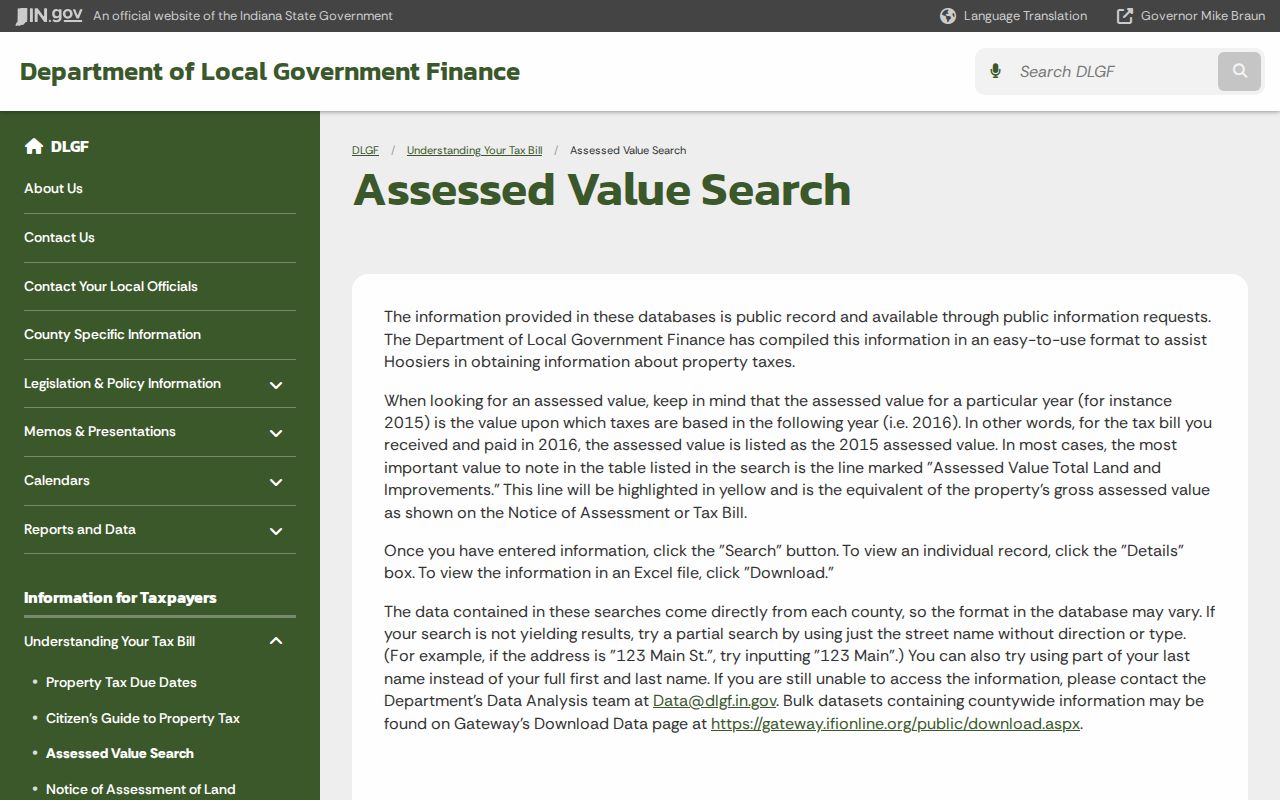
The screen holds the year constant. That makes it easy to compare a local property card with the state-reported value data side by side.
Starke County Reassessment Cycle
Indiana's cyclical reassessment now runs on a four-year schedule. It began July 1, 2026 for the 2026 Pay 2027 cycle. About 25% of parcels get inspected each year. The progress map dated July 14, 2026 placed Starke County at 40.84% in Phase I. That percentage measured inspection work rather than a countywide value change.
Local notices mention door hangers from exterior field agents. The reassessment office answers at 574-772-9166, and the Assessor at 574-772-9107. A field visit is not a sale or a permit. It shows parcel characteristics under review for assessment.
Note: Record the date on any reassessment progress map. The percentage is meant to change as inspections continue.
Starke County Damage Reassessment
A 2026 county storm and flood notice asked affected owners to preserve photographs, video, insurance claims, repair estimates, and receipts. Such evidence can support a post-damage value review. The record should name the date, the affected structures, the condition, and the repair scope.
This special review stands apart from a tax sale, a title record, or an ordinary market appraisal. A lowered assessment proves nothing about a sale price. An insurance estimate is not an assessor decision either. Ask for the resulting notice or an updated card.
Starke County Sale Price Evidence
The Recorder's Tapestry search accepts several angles. Grantor, grantee, recording dates, document number and type, consideration, subdivision, lot, block, parcel number, and legal-description terms all work as filters. Pull the most recent transfer. Record the instrument number, date, parties, legal description, and consideration exactly as shown.
Deed indexing in Starke County goes back to 1967. Scans run deeper still, to 1850, while mortgage indexing only begins in 1997. The assessment card carries a sale field too. Treat it as a hint. The recorded instrument plus any sales disclosure offer better context for the transaction.
Consideration can mislead. A dollar figure on a deed may reflect a trust, estate, life-estate, family, or entity transfer rather than an ordinary open-market sale. Compare the parties and the legal description before leaning on that amount. When the deed and the card disagree on dates, keep both rather than forcing them into one event.
Limits of Starke County Value
An assessed value exists for one job: taxation. Starke County does not promise that the figure equals a sale price, describes every repair, settles a boundary, or certifies title. The records still help careful research. A property card lists the assessed components and year, a deed documents a past transfer, and permit files may show work Planning recorded.
Before any purchase, weigh condition, live market evidence, and a qualified appraisal. Put the public record beside them. If the question is the tax bill, deductions, or an appeal, use the Starke County property tax records page. Value alone is not the amount owed.
Value versus price. Starke County assessed value is a tax measure, not a sale forecast or appraisal of present market value.
The Assessor keeps the property cards and assessment notices. Card copies run 10 cents each, and the staff can explain how a field was derived. Value disputes follow Form 130. Take that route through the DLGF appeal process instead of asking the Recorder to change the card.