
Trace Starke County Former Owners
Read the current recorded deed first. Its grantor conveyed the interest. That party becomes your next prior owner. Search the same name as grantee to find the deed through which the parcel was acquired, then repeat the move while matching the same legal description. The finished product is a backward timeline, not a loose set of names once tied to an address.
| Transfer Date | Grantor to Grantee | Deed Type | Book/Page or Instrument |
|---|---|---|---|
| Newest matching date | Immediate prior owner to current grantee | As stated | Copy exact reference |
| Previous matching date | Earlier grantor to that prior owner | As stated | Copy exact reference |
| Earlier book entry | Book-index grantor to grantee | As stated | Book and page |
| Parent tract or patent | Earlier chain or parent-county party | Deed or patent | Archive or book citation |
Never fill a missing row with an assessor name or directory occupant. A taxpayer of record is not always an owner of record. Leave the gap visible and keep working through the office index or deed book until a matching instrument appears.
Starke Deed Index Cutoffs
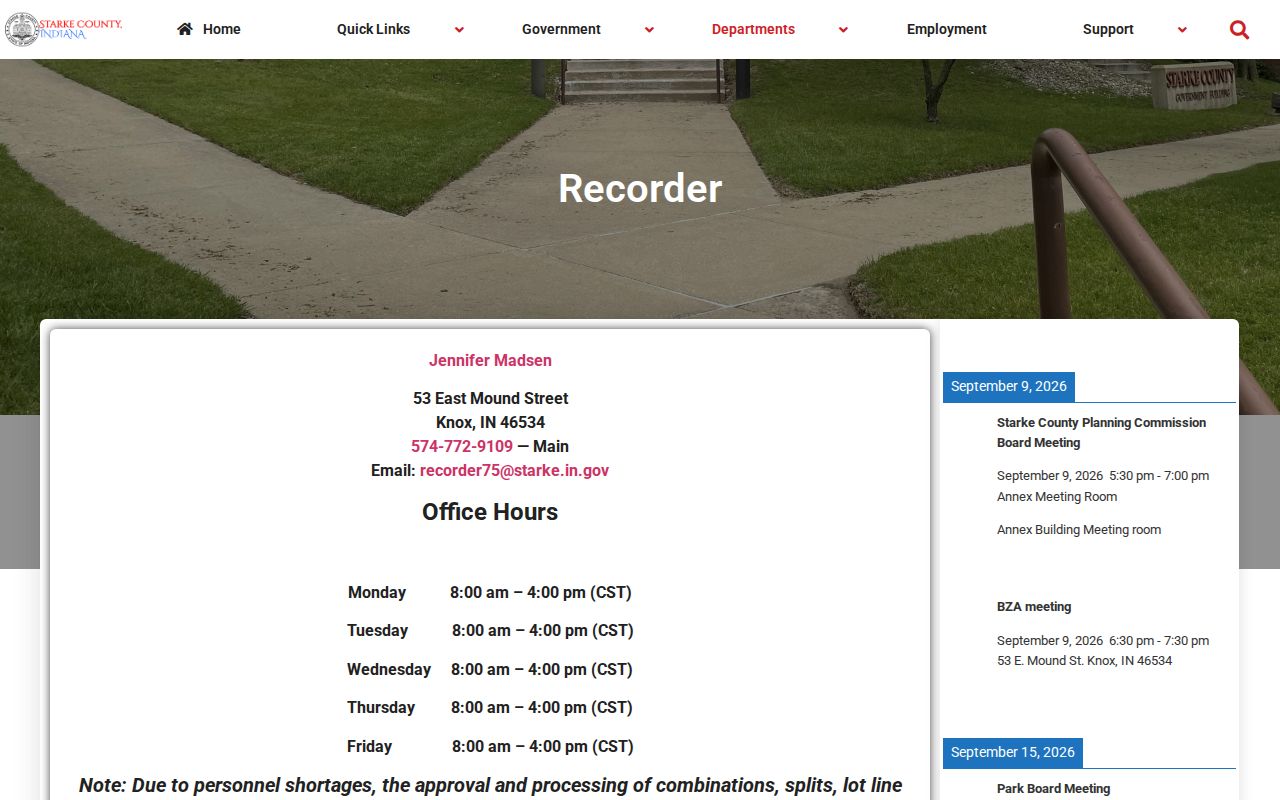
The Starke County Recorder offers scans back to 1850. Searchable indexes start later and differ by instrument. Deeds reach 1967, miscellaneous records reach 1961, and mortgages reach only 1997. An image can exist before a modern name index reaches it. So an early mortgage may still call for office research even when an older deed scan turns up online. The official Recorder page summarizes the county's coverage and access. Its account of the cutoff years shows why an online no-result should not end a search. Keep looking for former owners through other means.
The instrument-specific cutoffs mark a shift from typed index fields to book-and-page references rather than any loss of county deed records.
Online cutoff. Starke deeds are indexed to 1967, while scans are reported to 1850. Earlier prior owners may require deed books and office grantor-grantee indexes.
Go Back Through Starke Deeds
Tapestry is the Recorder's online index and image channel. Begin with a name and a date range, then narrow by deed type, subdivision, lot, block, parcel number, or legal-description wording. Index spelling can vary. Married names, initials, trust titles, estate names, and business names can connect one generation of former owners to the next.
- Locate the newest deed into the present grantee and confirm the parcel by legal description.
- Copy the grantor’s exact name, deed type, date, recording reference, and any prior-reference clause.
- Search that grantor as grantee in an earlier range, then match the same land description.
- Repeat until the online index stops, then request the proper grantor-grantee book and follow its references.
- Grantor
- The party conveying the stated interest.
- Grantee
- The party receiving the stated interest.
- Chain of title
- The linked sequence of conveyances for the same land.
- Reverse index
- An index used to follow one side of the grantor-grantee relationship backward.
- Quitclaim deed
- A conveyance whose stated assurances differ from a warranty deed.
Search Starke Former Owners Online
The Fidlar Tapestry information page describes the public paid-service channel for recorded-document searches and images. Paid access covers the indexed years only. Starke County's live document menu and image prices are set there, so inspect the current terms before paying. The county fee schedule controls office and certified-copy questions.

The portal bridges current deeds to past owners. It cannot erase the county's cutoff years. A later office search will not repeat those blind alleys. Try grantor and grantee separately. Use spelling variants. Widen the date range and test subdivision or legal-description terms, saving every term along the way. Then call or visit the Recorder at 53 E Mound St in Knox. Staff can point to an index or book. They cannot construct the chain or interpret title.
Reconnect Starke Plats and Parcels
Modern parcel numbers change through splits, combinations, and system formats. WTH has shown a segmented form such as 75-06-19-100-001.100-003. Tax-sale notices carry compact forms. Preserve both versions. Do not guess what each segment means. Let the legal description connect past owners whenever the APN does not.
For platted land, search subdivision, lot, block, planned development, plat, replat, street dedication, and alley vacation. Local clues include Carlson's Additions, Carlson Acres, Estok Acres, Vlad Estates, Boa Shores, Mont Resorts, Kellys Lot, Brabrooks, and Scovilles of Lot 2. They are search terms, not a roster. Match each hit to its actual plat and parcel.
Note: A changed Starke County parcel number can break an APN search even when the deed-book chain remains intact.
Resolve Starke Estate Transfers
Prior owners can vanish from a simple sale pattern. Death, survivorship, probate, or trust administration often intervenes. Search for personal-representative deeds, heirship affidavits, transfer-on-death deeds, survivorship instruments, and later conveyances. The Clerk and MyCase may hold a probate order explaining the authority behind the deed. A death certificate did not convey the land itself. Nor did a directory listing make someone an owner. Tie each estate event to a recorded instrument and the same legal description.
Historic Starke Address Clues
The Starke County Public Library holds 1940 and 1944 telephone books. They cover Knox, North Judson, Hamlet, and San Pierre. A 1941 Knox City Directory sits there too. The Indiana State Library guide points to microfilm, maps, newspapers, and county histories. It also reaches wills from 1855 through 1898. Such sources can restore an old street number, firm name, or spelling. That detail can unlock a deed index. Use each clue to produce a name and a date. Note whether it describes an occupant, subscriber, proprietor, or business.
Then return to the deed. This human-use bridge helps with rail-facing firms and rural roads. It also covers community labels that no longer match the current map. Keep a variant log for initials, married names, trade names, trusts, estates, and neighboring owners. Write down the directory year and page. That record makes the next grantor-grantee search reproducible. A listing is not a conveyance.
Early Starke Ownership Leads
Starke County was formed from St. Joseph County in the mid-nineteenth century, though sources disagree on exact creation and organization dates. The oldest chains may sit in parent-county records. State and federal land patents can also hold early transfers. Watch where the local book trail stops. Don't force every deed into one start year.
The Indiana State Archives and the State Library publish guides. These cover maps, microfilm, wills, and permanent records. Starke County suffered no known catastrophic courthouse loss. So an unexplained gap usually points to a filing quirk rather than a disaster. Ask the Recorder, Clerk, Historical Society, or Archives directly when a parcel chain stalls. A focused question beats an invented fire story every time.
How Far Starke Ownership Goes
Recorded property in Starke County reaches back to 1850. The recorder's scans deliver it once you hold the right reference. Anything earlier may live in parent-county volumes or federal patent files. The searchable fields do not go that deep. Note where Tapestry ends. The office index takes over from there, and the right physical book holds the next link in the chain.
Build each former-owner search as a dated chain that states plainly what every document proves. For a single recorded instrument, the Starke County deed records resource lays out the access path. It covers each step in order.
Lawful history research. Use former-owner records for title work, estate matters, house history, and purchase diligence. Never use historic or current addresses to stalk, target, or harass anyone.